Tuesday, October 02, 2007

3000th Argo Ocean Probe Launch

The 3000th Argo ocean sensor probe is to be launched from the RV Kaharoa off New Zealand.

The Argo program started in 2004 collects temperature, salinity and pressure readings from all of the worlds oceans with the 3000 sensor probes.


The robot sensors sink in the water to a depth of up to 2000 meters. When they reach the target depth they pump oil into an external bladder to allow them to float to the surface. As they rise they record the temperature and salinity readings. At the surface they transmit their position and data to a satellite then begin the cycle again. Each cycle takes about ten days.


The objectives of the Argo project are to get a better understanding of the oceans and the world's climate. The program has worldwide support.

Each probe is expected to last about 150 measurement cycles and they plan to replace 800 per year.
That is a lot of robots. Do not be surprised if one of the floats up in your bathtub one day.

Scoop: Maharey launching 3000th robot of the sea

See also: Legions of Ocean Robots: 2000th Launch

Labels: , ,

Monday, May 21, 2007

Underwater Robot Recovers Over 500,000 Silver And Gold Coins

Odyssey Marine Exploration (OTC:OMR) announced last week that they had recovered over 500,000 coins from a colonial period shipwreck.

They are keeping the location of the site, code named "Black Swan" secret until they have completed their salvage operations.

The find is worth at least US $500,000,000 based on an estimated average value of the coins, some in "dazzling mint state" condition, at US $1000 each. The estimate is considered preliminary because only 6000 of the half million coins have been inspected.

The remotely operated diver Zeus has allowed the salvage team to use "diligently followed archaeological protocols" to ensure that they get the best historical value from the sites. However, Odyssey claims that they have still not been able to determine the identity of the ships.
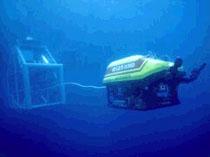
The Zeus is capable of diving to 2500 m (8200 ft). It weighs 8 tons in air with 8 thrusters and 2 seven function manipulator arms. It is connected to the surface through a fiber optic umbilical for telemetry and high-definition video.

The treasure, they say, was recovered from "beyond the territorial waters or legal jurisdiction of any country," but they still expect other claims on the booty.

I think, technically, it all belongs to the robot, since he was the one who made the recovery possible, but it will be shared with he investors in the company.


Odyssey's Latest Shipwreck Find Yields Over 500,000 Silver And Gold Coins - Press Release

Labels: ,

Wednesday, April 11, 2007

New Robots Clean Pools

Home vacuum robot maker iRobot (NASDAQ: IRBT)has launched two new pool-cleaner robots for home use.
The two robots, Verro 300 and Verro 600, are available now for $800 and $1200.
The 300 model uses water jet and vacuum to suck up debris from the pool. The Verro 600 uses brushes along with the vacuum and filter.

Drop the robot into the water and it will clean the pool in 60 to 90 minutes. The robots require a power umbilical plugged in but do not need any hose connection to the pool's pump.
They will also not gawk at your sunbathing teenage daughter.

Will pool robots put pool service companies out of business? No. There is a lot more to maintaining a pool than sweeping up the leaves.

Pool cleaning robots are not new by any means.
iRobot worked with the Aqua Products Group companies to develop their robots.
Another maker of pool cleaner robots is Maytronics in Isreal.


iRobot Corporation: Press Release

Labels: , , , ,

Wednesday, December 06, 2006

Robot Lobster

A new exhibition called Design Life Now: National Design Triennial 2006, is opening at the Cooper-Hewitt National Design Museum in NYC. It will run from December 8 until July 29, 2007.

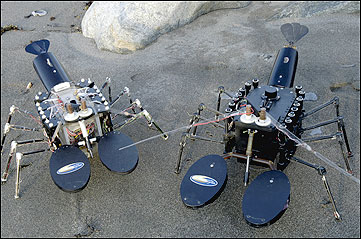
One of the design technology examples on display are robot lobsters designed to crawl along the bottom of coastal areas to monitor the environment or search for mines.


The robot lobster are from the Biomimetic Underwater Robot Program at the Marine Science Center of Northeastern University.

The underwater robots are based on the neurophysiology and actual behavior of lobsters. The biomimetic design allows greatest performance and adaptability of the robots to the rocky bottom where they operate.

The lab, led by biologist Dr. Joseph Ayers, is also working on another underwater robot modeled after the eel-like lamprey which is propelled through the water by the undulations of its body.


Cooper-Hewitt, National Design Museum | National Design Triennial: Design Life Now

Labels:

Wednesday, August 23, 2006

Robots to Help With Oil Mess

Japanese company Fukada Salvage and Marine Works Co. Ltd. are expected to bring on underwater robots to help with the salvage of the M/T Solar I in Guimaras province Philippines.

The M/T Solar I sank August 11 spilling millions of liters of oil into the sea. It is not clear if oil has stopped leaking from the vessel that sits on the bottom at a depth of 640 meters (2,100 feet).

The robots will be used to first find the ship then to hook-up and suck the remaining oil out of it. There could be almost 2 million liters (50,000+ gallons)of bunker oil - oil used for fuel rather than cargo - left in the tanks.
If the ship is sitting upright then the robots can connect lines to the valves and drain the tanks. If the valves are blocked then they can cut a hole and "hot tap" the tanks to connect a drain hose.
After the oil is drained salvage workers will attempt to raise the ship.

The local government and residents are irate that the ship has been allowed to sit and spew oil. Some are calling for a boycott of Petron Oil who had the ship under contract. Petron is majority owned by Philippines governement. The ship was owned by Sunshine Maritime Development Corp.

Side note:

To me, it seems that this disaster has gotten very little publicity. The spill has reportedly destroyed 220 kilometers (136 miles) of the Guimaras coastline and displaced up to 26,000 people. The economy of this area depends on fishing and tourism so this contamination of the coast is truly devastating. Earlier this week the governor of the province was calling on citizens to donate materials to be used to make booms to contain the oil and prevent the damage from spreading. Where is the worldwide response to this type of disaster?

The people of Guimaras are asking for help. They have set up a web page Project Sunrise to keep people posted on what is happening and to let the world know how they can help.

It is widely known that the quicker an oil spill can be contained the less the damage. It seems that every major oil spill spreads out of control and kills hundreds of square miles of ocean before anyone does anything. This problem is not going to go away. I think the UN should sponsor an emergency response team to rush to any oil spill in the world to help minimize the damage. That's what I think.
Someone should invent some robots to contain the spill when they happen then to clean up the mess afterward.

Labels:

Thursday, August 03, 2006

School of Underwater Robots Plays as a Team

Data collection this August in Monterey Bay, California will cap a three year cooperative effort involving a team of research scientists and underwater robots.
The program called Adaptive Sampling and Prediction (ASAP), was led by Naomi Ehrich Leonard of Princeton University and Steven Ramp of the Naval Postgraduate School.
The team includes scientists from all over the world and an autonomous underwater team from Woods Hole Institute and Scripps Oceanography Institute.

The objectives of the project include studying the seasonal ocean currents of the area.
The underwater robots will be able to make decisions about where to take measurements. Usually with studies like this the robots must be pre-programmed to make sure they cover the entire area. In this case the robots will decide for themselves how best to cover the interesting changes and get the most data.

The self-directed school of robot submarines may one day be able to be set free for more wideranging tasks. they could follow oil spills, fish migrations or help with military operations.

ASAP Project page


Underwater robots work together without human input

Labels:

Friday, July 14, 2006

Live Dive 2006

I recently posted about vacation tele-tours where tourists could participate in underwater dives by watching through the eyes of a remote operated vehicle, ROV.

Well, here is an opportunity to see one for yourself.


On Saturday July 15, The National Undersea Research Center at University of Connecticut and US NOAA will be showing a live webcast of the exploration of a shipwreck off the coast of Massachusetts.

The site is where the four-masted schooner Frank A. Palmer and the five-masted schooner Louise B. Crary collided and sank in 1902.

The webcasts will be in two 30 min segments while live DVD quality images will be shown to visitors at the Gloucester Maritime Heritage Center.

Viewers will be able to explore the wrecks at the same time as archeologists.


Live Dive 2006 Home

Labels:

Monday, July 10, 2006

Undersea Adventure By Robot

A manufacturer of remote piloted underwater vehicles, SeaEye Marine, has announced that they have sold two of their Falcon ROV's to underwater tour operators.

One unit is going to Roving Eye Enterprises who has been operating the tour service out of Scotland for 10 years. Tours take visitors out to the Scapa Flow, an area where the German fleet scuttled 74 battleships at the end of the First World War rather than let them fall into enemy hands. The tourists can view the remains of the ships through the eyes of the ROV directed through the wreckage. This is an ROV upgrade for them.

The other operator is Caribbean Undersea Adventures in the British Virgin Islands. CUA takes tours to fly through the wrecks from the 1700's as well as the RMS Rhone, a steamship that sank during a hurricane.
The advatages of using an ROV is that non-diving tourists can experience exploring the shipwrecks and can go much deeper than divers.

The published rate for a half-day excursion and dive is $65 per person. This seems to me like a fairly cheap rate. I wonder how much they could charge for the experience from a more remote location. For example would people be interested in taking this virtual dive from a science museum in Kansas?

What other tele-tours might people be interested in? A tour through the core of a nuclear reactor? A trip down the throat of an active volcano? Exploration of Antartica?
Just takes a little money...

Seaeye - What's New

Labels:

Monday, June 26, 2006

Underwater Competition

I had the opportunity to go to the 5th Annual International ROV Competition organized by the Marine Advanced technology education Center, MATE.

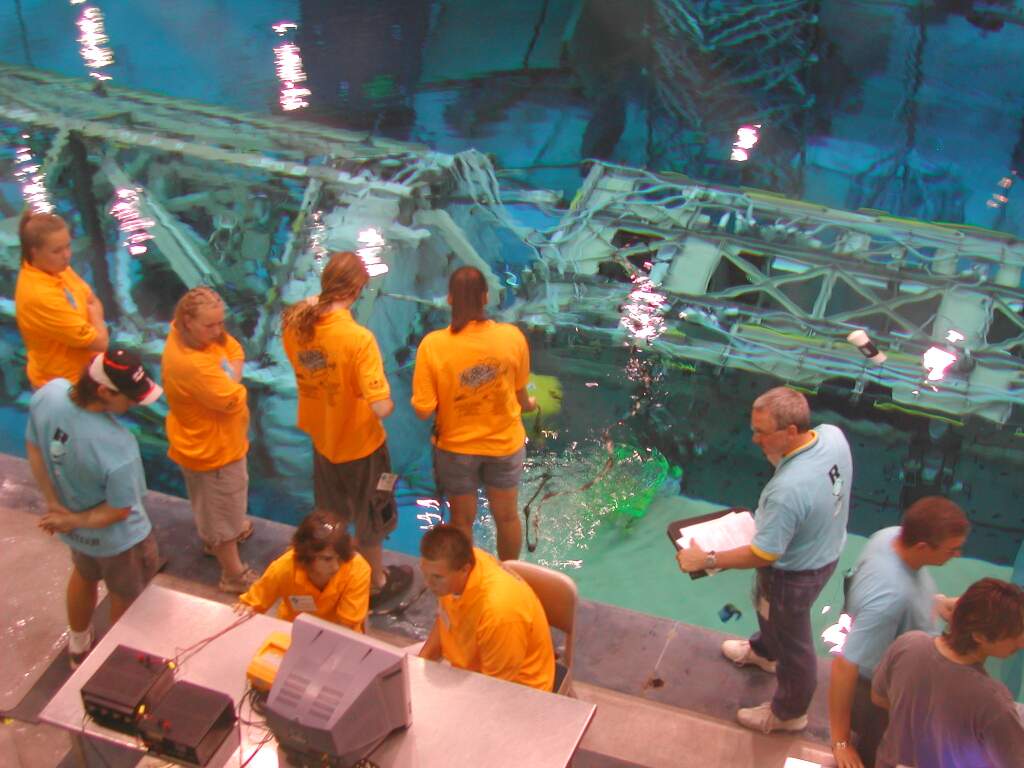
The competition is for college and high school teams to perform underwater tasks with ROV's that they have designed and built themselves. The underwater action took place at the NASA Johnson Space Center neutral buoyancy pool in Houston Texas.

I was very impressed with the professionalism of the ROV designs and the teams. There were more than 40 teams competing from all over the US, Canada and a few from Hong Kong. The teams at this event got there by winning a regional contest.

The contest venue, the NASA neutral buoyancy lab, is impressive by itself. It is the giant swimming pool where astronauts train for weightless work in space. It has mock-ups of the international space station and space shuttle cargo bays under the water. The MATE group used just a small portion of the pool.

It is hard to convey the scale of the pool with pictures from a little digital camera. In the picture above you can see the contest platform at the right end of the pool where the people are standing.
Below it in the water is the space shuttle cargo bay mock-up. You can also see the reflection of the second story control room. There were operating video cameras underwater so you could watch the live action from the control rooms and display area.

The judging is not only on the ROV and performance during the tasks but the teams also have to present to technical judges. I talked to a few of the teams and found them all to be way smarter than I was at that age. They knew about their ROV but also knew about other designs. They were somewhat restricted by the rules of the contest and almost everyone I talked to told me about ways that they could make their machine go faster or lift more weight.
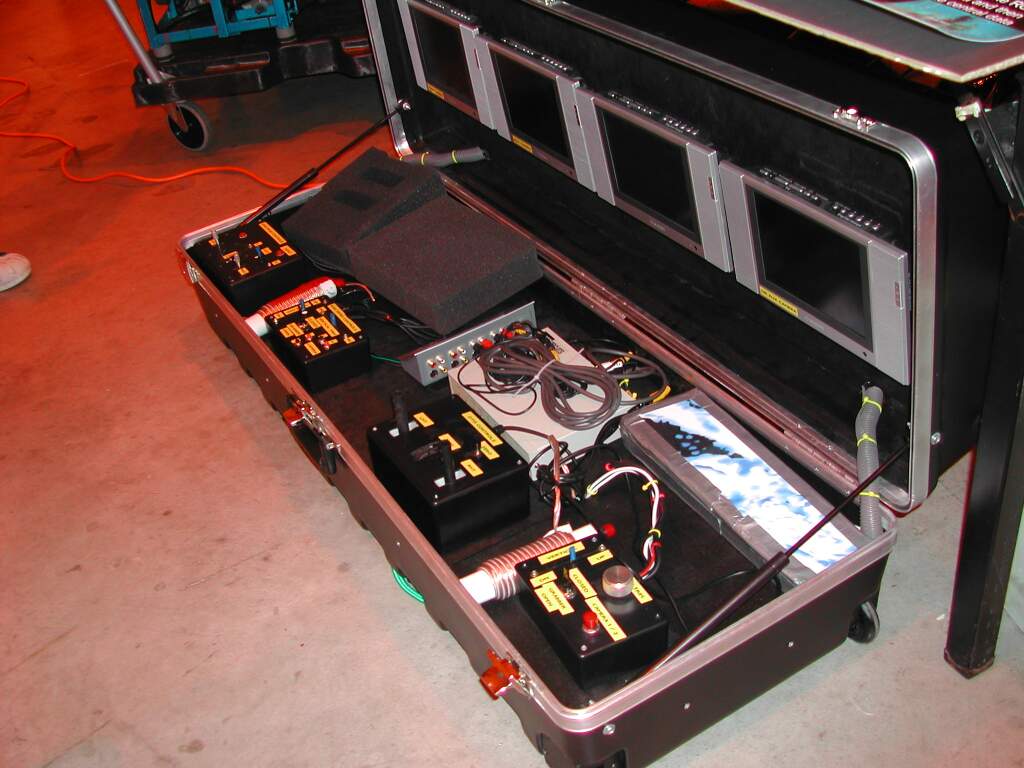
One group I spoke with was the Falcon Robotics Team from Carl Hayden High School in Phoenix, Arizona. I did not know at the time that they were already sort of famous. There have been articles and maybe an upcoming movie about them. The team started with a bunch of high school kids who were on the verge of dropping out of school from dis-interest, need to get a job, citizenship problems, etc, - to go on to beat MIT in a national competition. An inspirational story. At the time, I was just grateful that they took the time out to explain everything to me. Their control system was particularly impressive. Everything, including the video monitors, was mounted in a travel case such that it just popped open ready to use.


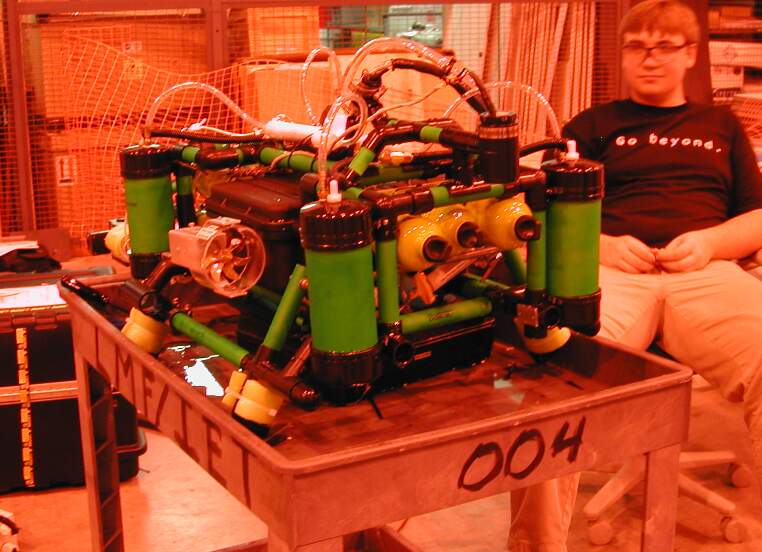
Another team I talked to briefly was from COSI Academy in Columbus, Ohio. This was a bunch of kids from different high schools who formed the team through the science museum. I was attracted to their work area by their very well constructed ROB. It was a very symmetrical, a nice green color and just looked like there was a lot of work in it. Yes, I am easily amazed. However, the real story of most of the teams is not about the ROV but about how they got there. In most cases, especially among the high school teams, the kids really drive the program. It seems that one of their toughest problems can be finding sponsors both for money and for guidance for the teams.
The amount of work and creativity that goes into these projects is not something that you could tell someone to go out and do. The teams are completely self-motivated to invent this incredible new stuff.

Labels: ,

Friday, June 02, 2006

Combo Swimmer and Crawler for Ship Hull Inspection

SeaBotix and Vortex HC have joined efforts to build the ultimate ship's hull inspection robot.

The Little Benthic Crawler, LBC, swims like a submariner ROV then sucks onto the ship hull and rolls like small truck.
The LBC makes it possible to perform a quick-search inspection of a hull or other underwater structure but also stop and perform detailed inspection when needed.

Working prototypes have been built (see videos) and the final version of the LBC is planned for sale toward the end of 2006.


SeaBotix Inc. - LBC Hybrid ROV/Crawler

Labels:

Monday, April 24, 2006

Madeleine the Robot Turtle

Tom Simonite

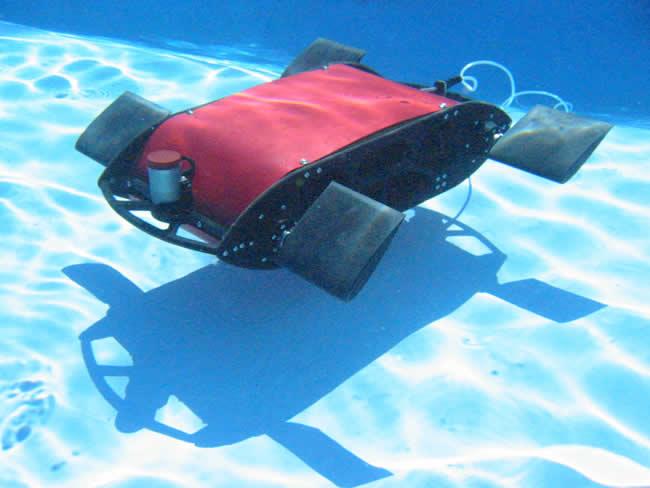
A robotic turtle could help engineers build better autonomous underwater vehicles and answer fundamental questions about how prehistoric beasts swam. The robot, called Madeleine, is already helping researchers understand when it is best to swim with four flippers and when to use two.

Madeleine is similar in size and weight to a Kemp's Ridley or Olive Ridley sea turtle, measuring 80 centimetres by 30 cm and weighing 24 kilograms. The robot also has a comparable power output, between 5 and 10 watts per kilogram, depending on how hard it is working.

However Madeleine includes on-board sensors: sonar, video, depth, altimeter, accelerometer.

By imitating the design of a turtle, the researchers hope to build more efficient ocean robots, with flippers. "The thinking is that if nature did it, it must be good," explains John Long, one of Madeleine's makers from Vassar College, in New York, US

Long and colleagues used their robo-turtle and a swimming pool to experiment with different forms of flipper propulsion. They showed that four flippers are best for acceleration and stopping, while two flippers are more efficient for simply cruising along.

See a movie here

New Scientist SPACE - Breaking News - Robo-turtle answers some flippery questions

Labels:

Thursday, February 23, 2006

Underwater Robots Eavesdrop on Whales

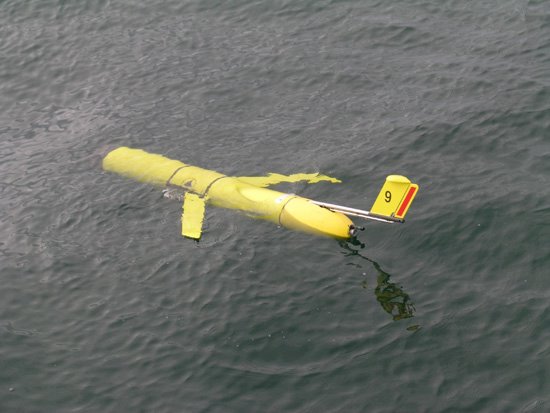
Scientists at the Woods Hole Oceanographic Institution (WHOI) have reported the first use of passive acoustic recorders in an ocean glider, a type of AUV that looks like a large model airplane and can work in water depths to 1,000 meters (about 3,300 feet) or more.

Gliders move both horizontally and vertically in the ocean and work around the clock in all weather conditions, typically up to a month or longer depending on the project.
The vehicle carries a variety of high-resolution sensors to collect oceanographic measurements such as temperature, salinity, and fluorescence (a measure of phytoplankton abundance).
Gliders also operate silently, which make them ideal for passive acoustics studies. Researchers say the gliders are a promising, cost-effective, and efficient alternative to long-term ship-based studies given ship costs in the thousands of dollars a day.

Mark Baumgartner, an assistant scientist in the WHOI Biology Department, reported findings from a pilot study involving the deployment of recorder-equipped gliders.
They are finding that the capabilities of this new observing platform allow ecological research that has not been previously possible.

Future work will focus on extending the duration of the recordings, developing a capability to report detections of whale vocalizations to land-based researchers in real time, and monitoring the high-frequency vocalizations of other marine mammals, such as dolphins, sperm whales, and beaked whales.

WHOI : Media Relations : News Release : Monitoring Baleen Whales with Autonomous Underwater Vehicles

Labels:

Friday, February 17, 2006

Swim With the Robot Sharks

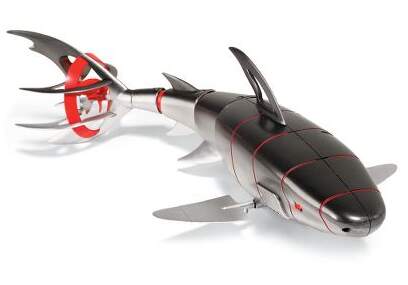
A robot shark would be the perfect guest in any pool. Especially at night.
This guy is 2 feet long and can swim in water up to 9 feet deep. The remote controller is also waterproof so you can join your shark friend in the pool.

It comes in two models, red or blue propeller. They also operate on different frequencies so you can run two in the same pool. Robot Shark Sumo!

Retail at US $100.

Remote Controlled Robotic Shark at Hammacher Schlemmer

Labels:

Friday, February 03, 2006

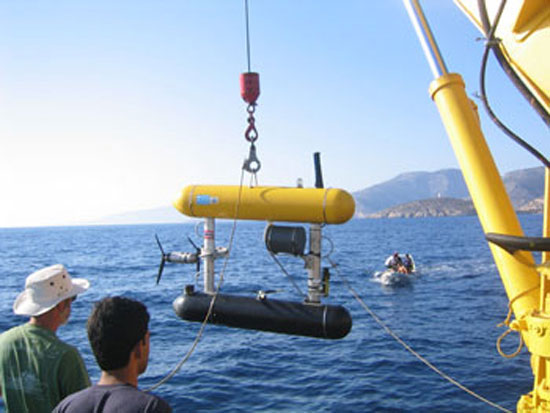
Underwater Autonomous Robot Finds Ancient Greek Shipwreck

After lying hidden for centuries off the coast of Greece, a sunken 4th century B.C. merchant ship and its cargo have been surveyed by an international team using a robotic underwater vehicle. The team accomplished in two days what it would take divers years to do.

The Chios wreck demonstrates how advanced technology can dramatically change the field of underwater archeology, completing in two days what would have taken SCUBA divers using conventional methods years to accomplish.

Using a novel autonomous underwater vehicle (AUV) named SeaBED developed and operated by Wodds Hole Oceanographic Institutue, WHOI, the team made a high-precision photometric survey of the site using techniques developed by WHOI and MIT researchers over the past eight years.

For a single three-hour dive, SeaBED was programmed to “fly” over the shipwreck site in precisely spaced tracks. Multibeam sonar completely mapped the wreck while a digital camera collected thousands of high-resolution images. The vehicle took 7,650 images on four dives to reveal the ship's ceramic cargo and marine life, including bright yellow sponges and colorful fish. The vehicle did not touch the wreck, leaving it in an undisturbed state, important for future studies.

Robotic technology is the only way to reach deep shipwrecks like the one at Chios, but the systems can also be applied to shallower sites.

“By using this technology, diving archeologists will be freed from routine measuring and sketching tasks, and instead can concentrate on the things people do better than robots: excavation and data interpretation,” contends Singh, an engineering and imaging scientist. “With repeated performances, we'll be able to survey shipwrecks faster and with greater accuracy than ever before.”

WHOI : Media Relations : News Release : Autonomous Underwater Vehicle Maps Ancient Greek Shipwreck

Labels:

Sunday, October 16, 2005

Robots Join Nuclear Sensor Lineup

by Casey Dickinson, Journal Staff

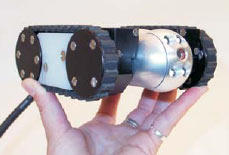
HORSEHEADS, New York — Robots will be the latest addition to Imaging and Sensing Technology, Inc.’s (IST) lineup of sensing and inspection equipment for the nuclear-power industry. IST has acquired the exclusive worldwide marketing and manufacturing rights for the Inuktun line of mobile robots used for nuclear inspection and repair.

British Columbia–based Inuktun Services, Ltd. manufactures camera-equipped robots that can operate underwater and in other hazardous conditions.
Inuktun Nanomag


IST and Inuktun signed a five-year, renewable agreement for an undisclosed sum, says Donald Hartman, CEO of IST. The deal will help bring Inuktun’s robots to a wider audience in the nuclear-power industry through IST. The company’s products are known in North America, Hartman explains, but can benefit from IST’s worldwide market.

The Central New York Business Journal

Labels:

Friday, September 16, 2005

Underwater Robot Begins Recovery Surveys

From C&C press release...

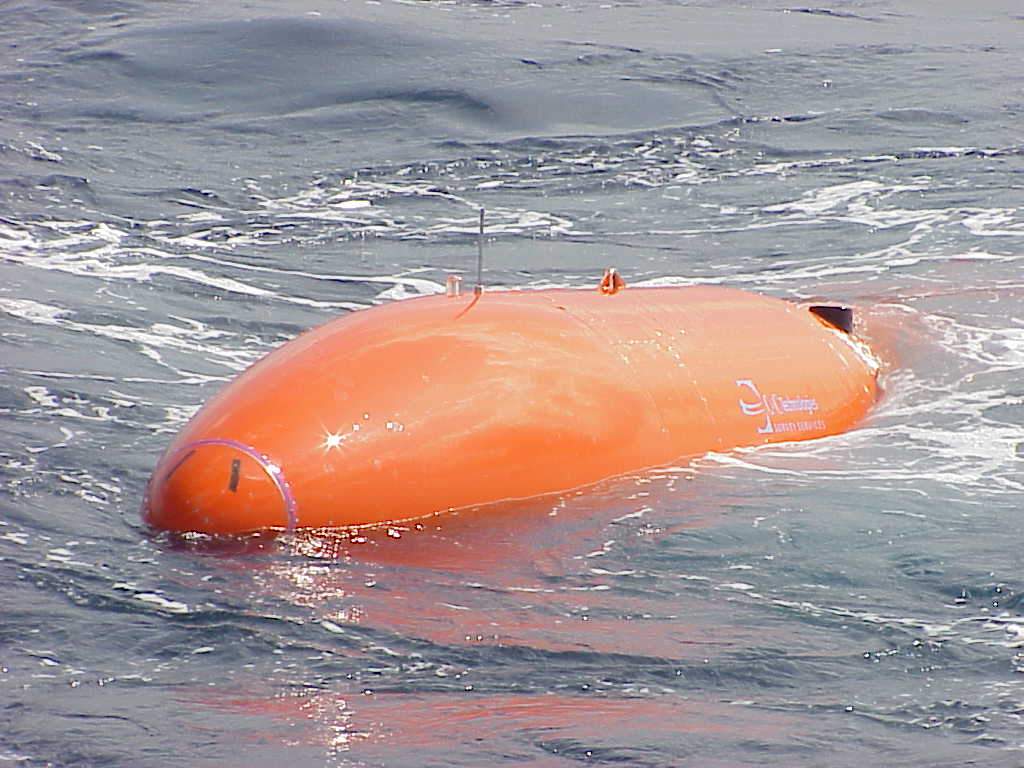
C & C Technologies' second deepwater AUV, C-Surveyor II™, recently began field operations in the Gulf of Mexico.
he C-Surveyor II AUV is modeled after C & C's existing state-of-the-art AUV, C-Surveyor I, and includes numerous advancements.Survey sensors onboard include a multibeam echosounder, chirp side scan sonar, chirp sub-bottom profiler, methane detector, CTD system, and an Edgetech DW106 sub-bottom profiler customized with narrow transmit and receive beams to permit significantly deeper seabed penetration.


Over the next three months, C & C will be performing various surveys for government agencies, as well as the oil and gas industry. These projects include block hazard, pipeline hazard and investigation surveys.
Home :: C & C Technologies :: Survey Services

Labels:

Tuesday, September 06, 2005

Underwater Robot Runs on Solar Power

Rensselaer Researcher To Showcase New Solar Underwater Robot Technology at Exhibition on State-of-the-Art U.S. Robotic Vehicles

ARLINGTON, V.A. – A new solar-powered underwater robot technology developed for undersea observation and water monitoring will be showcased at a Sept. 16 workshop on leading-edge robotics to be held at the National Science Foundation (NSF) in Arlington, Va.

Arthur C. Sanderson, professor of electrical, computer, and systems engineering at Rensselaer Polytechnic Institute, will display the robotic technology being developed by a team of research groups, including Rensselaer, and led by the Autonomous Undersea Systems Institute directed by D. Richard Blidberg.


As the principal investigator of an NSF-funded project called RiverNet, Sanderson is working collaboratively with other researchers to develop a network of distributed sensing devices and water-monitoring robots, including the first solar-powered autonomous underwater vehicles (SAUVs).

The SAUV technology allows underwater robots to be deployed long-term by using solar power to replenish onboard energy.
According to Sanderson, the SAUVs communicate and network with one another in real time to assess a water body as a whole in measuring how it changes over space and time. Key technologies used in SAUVs include integrated sensor microsystems, pervasive computing, wireless communications, and sensor mobility with robotics.
The SAUV weighs 370 pounds, travels at speeds of up to 2 miles per hour, and is designed to dive to depths of 500 meters.


RPI: News & Information - Rensselaer Researcher To Showcase New Solar Underwater Robot Technology at Exhibition on State-of-the-Art U.S. Robotic Vehicles

Labels:

Thursday, July 28, 2005

Underwater Robot Lumberjack

Robot lumberjack dives to flooded forests

A chainsaw-wielding robotic submarine is roving beneath Lois Lake in British Columbia, Canada.

The submarine is chopping down a forest submerged decades ago when the valley flooded due to a hydroelectric dam. After it cuts the trees, they float to the surface, where they dry out and are sold to mills for use in furniture and construction.

Triton Logging of Vancouver, British Columbia, has been harvesting them for years by sending divers down with chainsaws and hoisting the waterlogged trunks to the surface. But diving is very slow and dangerous, so Triton has developed a remote-controlled sub to do the job.

Sawfish


Called the Sawfish, the 3-ton, 3.5-metre-long, yellow submersible has high-resolution cameras that an operator on the surface uses to guide it. After grasping the base of the tree in pincer-like arms, it attaches an inflatable flotation bag, which it fills from its compressed air supply. Finally, it uses its 1.5-metre chainsaw to cut the tree and lets go of the trunk, allowing the flotation bag to carry it to the surface for retrieval. Triton's president Chris Godsall said Sawfish can cut 36 trees in three or four hours, operating as far as 300 meters down.

ISA | Robot lumberjack dives to flooded forests

via RoboticsDaily

Labels:

Saturday, June 04, 2005

Underwater Robot Aids United Nations in Tsunami Cleanup

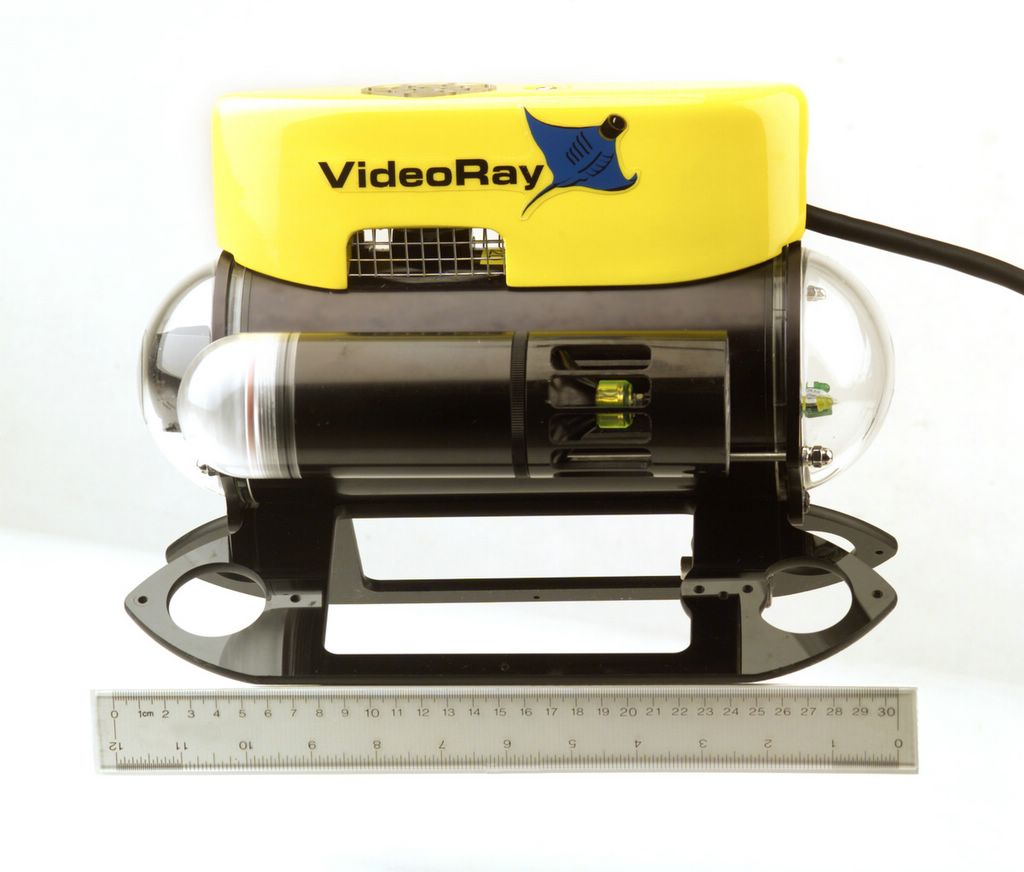
VideoRay Underwater Robot Aids United Nations in Tsunami Cleanup

Remotely Operated Vehicle (ROV) rushed to Phuket, Thailand with Expert Training

The United Nations Office for Project Services (UNOPS - www.unops.org ) is coordinating the UNDP Reef Recovery and Rehabilitation Project in Thailand, along with the Phuket Marine Biological Center (PMBC - http://www.pmbc.go.th/English/English.asp ).

Underwater helper

"We need to get the tonnes of debris from houses, boats, and other man-made material which fell on the reefs removed as quickly and efficiently as we can, using mainly volunteer labor." Said Ms. Hill. "We're very excited about the use of VideoRay - a device that has no limits on depth, dive time, or the other physiological constraints we must live with when we dive. The VideoRay will check out sites before we dive them, and work alongside of divers during cleanups - saving us time and making us far safer and more efficient. And, with the ability to capture video and stills to our laptop computer, we'll have better documentation of our project."


VideoRay Underwater Robot Aids United Nations in Tsunami Cleanup

Labels:

Friday, June 03, 2005

Underwater Robot Woodstock

Autonomous Undersea Vehicle Fest 2005

With more than 40 vehicle systems from 17 organizations participating, AUV Fest 2005 will be the largest such in-water AUV event ever conducted, both for the number of AUV demonstrations as well as the number of vehicles operating simultaneously at a Navy underwater range facility. The event is focused on assessment of maturing AUV/UUV technologies, new vehicles, cooperative behavior, & Fleet mission applications.


Labels: