Remote Controlled Pigeons
A team of scientists from the Robot Research Center at the Shandong University of Science and Technology have implanted radio receiver electrodes in the brain of pigeons to control them.
The scientists can make the pigeons hover, fly or turn right or left through a computer control.
"Chief scientist Professor Su Xuecheng explained the pigeon does not feel sense of pain at the head and failures will not influence the pigeon's life."
In fact, the control will allow the pigeons to be less of a threat to social stability and national unity in China.
Welcom to Changsha!
Also:
Zombie Mice Robots
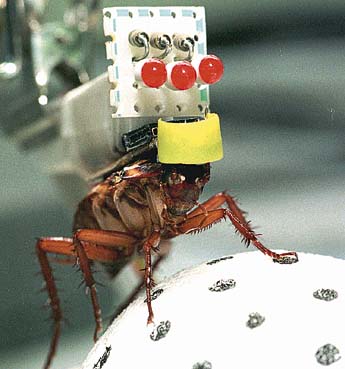
Robot Zombie Cockroaches

The scientists can make the pigeons hover, fly or turn right or left through a computer control.
"Chief scientist Professor Su Xuecheng explained the pigeon does not feel sense of pain at the head and failures will not influence the pigeon's life."
In fact, the control will allow the pigeons to be less of a threat to social stability and national unity in China.
Welcom to Changsha!
Also:
Zombie Mice Robots
Robot Zombie Cockroaches
Labels: biorobotics, cross-species relationships, cyborg
posted by Prospector at
2:34 PM
0 Comments