Tuesday, May 29, 2007

Robot Fence Shows Cows Where to Go

Robots not only take on unpleasant tasks but they can enhance and improve on human efforts.

Another farmer's helper robot: The Voyager robot fence from Lely.

The robot fence is an electrified fence that keeps your cows from running away, like any good fence. But this smart fence also occasionaly moves a few feet to give the cows fresh grass to graze. When they get to the end of the field, the robot fence can move the herd back to the beginning again to start all over. It gives the cows fresh ground and allows the field to recover.


According to the website:
"Frontal grazing by means of the Voyager is a method of intensive grazing management that allows livestock to continuously graze on fresh forage. Because the cows have a small strip of fresh pasture each time, the grass is well cropped and dosed, which not only makes the rumen function better, but also achieves a better proportional intake of protein and sugars."

Happy cows, better milk.

The fence consists of two 4-wheel skid-steer robots that keep the electrified line properly tensioned between them. Each robot is about 125 cm (4 feet) square, 215 cm (7 feet) tall and weighs 170 kg (375 lbs. They communicate through bluetooth so they can compensate for obstacles or unlevel ground.

The robots are powered by solar panels so they can operate autonomously. They are pre-programmed to optimize the forage. The farmer only needs to tell the robots how many square meters of new field per day and the robots calculate how far forward to move.

Voyager

Labels: ,

Wednesday, October 11, 2006

Search and Destroy Weedkiller Robot

In the future, farmers will look back on old farming techniques and marvel at the wastefullness of dumping tons of chemicals all over the ground. Why didn't they just put the treatments where they are needed?
We have already seen this idea applied to kill bugs. Now it is also used for killing weeds.

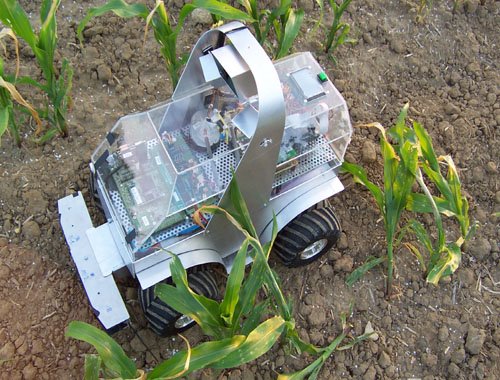
Here is an example of a way that robots can be used to target weed killing herbicide on the farm. This robot is solar operated for long days in the field. It uses stereo vision to search out weeds among the crops. When it finds a weed, it reaches out with a special cutter arm and chops it off. Next it sprays the remaining stem with a squirt of herbicide. So there! Nasty weed!


A team of engineers led by Dr. Lei Tian at the University of Illinois came up with the idea of the solar driven robot from other research they were doing. While working on remote sensing of crops they have to walk the rows taking measurements to compare actual readings to remote data.
One day, one of the poor overworked grad students fainted from the heat. Maybe there was a better way than grad student slavery?
Their first robot was okay but the batteries ran out every couple of hours. So the solar panels were added to supply continous power. And the panel shades the cameras for better visual identification.

The robot rolls through he fields at about 3 miles per hour (4.8 kmph) and uses GPS, ultrasonic and vision for navigation. The next version will take soil measurements and check the crops. Like the farmer Scout robot.

U of I Robots Go Solar; New System Could Drastically Reduce Herbicide Use

Labels:

Tuesday, October 03, 2006

Farm Robot Scout

The founders of Vision Robotics Corporation have applied for a US patent on an agricultural robot that uses a vision and mapping to guide harvester robots through the farm.

The patent proposes that a scout robot is first sent through the farm or orchard to map out the fruit, weeds, plants that need trimming or other farm work that needs to be done. Once the farm is mapped - for example all of the ripe fruit located - then a plan is formulated. Once the plan is done then the robot goes about its harvesting or maybe a team of harvester robots are sent out to pluck the ripe fruit.

Their innovation is the use of a scout robot to visually record and map the details of the orchard before work begins.
Having an accessible view of the plants will save time walking the farm and will also help optimize the use of the harvesting machines.
Other organizations are investigating using autonomous flying robots to get a good look over their farm.

US Patent application 20060213167

Labels:

Thursday, June 29, 2006

Robots Shunned By Many Farmers

According to an article in the online edition of the Florida newspaper HeraldToday.com Florida farmers would like to get robots to help in their harvest but thr robots just can't compete with people.

Only ten percent of Florida's crops are harvested by automatic machines even though a shortage of farm workers is trying to drive the numbers higher.

It turns out that there is more to harvesting some fruits than just shaking the trees. Oranges, for example, have both ripe and immature fruits on the same branch. A picker must be able to tell the difference.

A recent innovation may be to dump 300 gallons per acre of a chemical called CMNP on the orange trees to make the ripe fruit fall off easily without harming the young fruits. That way an automatic tree-shaker could grab only the good stuff. However, the chemical approach has not been approved yet. And maybe there could be some unintended consequences?

But there are many more crops that machines cannot pick.
"We don't mechanically harvest tomatoes, peppers, strawberries, watermelon, cantaloupe, eggplant or cucumbers," Phyllis Gilreath, a Manatee County, Florida extension agent said. "Cabbage is even handpicked.

This year, according to the article, the county has had a severe shortage of farm workers and interest in robot farm workers is growing.
It is hoped that universities can play a major role in finding robot solutions for more farm problems. Maybe ideas from contests like the recent Field Robot competition in Germany can be extended from harvesting golf balls to harvesting strawberries.

Bradenton Herald | 06/29/2006 | Farms seek scientific future

Labels:

Robot Farmers Compete

Farm robot inventions descended on the University of Hohenheim in Stuttgart, Germany last week to compete for titles in the Field Robot Event 2006.


The robots matched skills on drawing field lines, maneuvering through Fields, finding dandelions, speed racing and freestyle demonstrations of skill.
Advanced competition included searching for holes and debris on a playing field.

The 'dandelions' were actually yellow golf balls - but the idea is there. If the farm thing doesn't work out they could always get a job at a driving range.

The overall winner out of a field of contestants from all over the world was MAIZERATI from Osnabruck, Germany.

Field Robot Event Website

Labels:

Tuesday, March 07, 2006

Robot Mushroom Picker

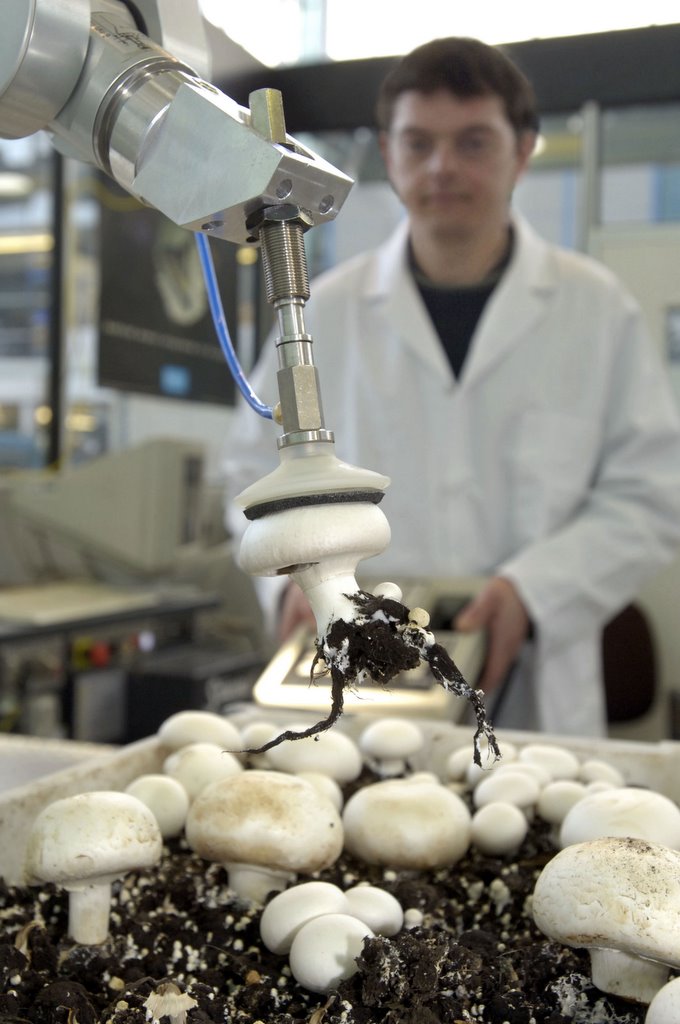
Engineers from University of Warwick's horticultural school, Warwick HRI, have designed a robot to help mushroom farmers.
The robot finds only perfectly ripe mushrooms and gently picks them with a suction cup and quick twist of the wrist.
So far, the robot is only half as fast as human pickers but it can work 24 hours a day, does not make mistakes, and does not require flogging.

Robots To Slash Farm Labour Costs

Labels:

Monday, February 13, 2006

Farm Robots to Compete at World Cup

This year's compettion for agricultural field robots at University of Hohenheim in Suttgart, Germany has an additional event this year.

Past competitions have included speed races, navigating through corn fields and counting dandelions.
This year, in honor fo the World Cup Finals in Germany, the robots will be competing on a soccer field (or football pitch). The task - find holes in the grass, trash on the field or other damage. June 23 and 24, 2006.


Teams travel from all over the world for the annual Field Robot Competition.
Field Robot Event Website

Labels:

Friday, September 16, 2005

Robot Farm Worker Pulls Weeds

Weeding is a major problem for ecological growers since it is both expensive and time-consuming. New robot technology may have the solution. In a new dissertation, Björn Åstrand, from Halmstad University in Sweden, presents how weeds can be removed mechanically -with the fully automated robot Lukas.

“For an ecological grower of beets, weeding can cost about SEK 10,000 per hectare. With robot technology we estimate that these costs can be cut in half. In the long term this technology would also mean major environmental benefits by ultimately replacing chemical herbicides in traditional cultivation,” says Björn Åstrand, who works at the School of Information Science, Computer and Electrical Engineering at Halmstad University.


The robot can automatically make its way around a field and remove weeds both between cultivation rows and in the rows, between plants.

An infrared camera is installed on the robot to read the rows. The images are processed using a specially developed computer program that in turn steers the robot’s wheels and weeding tool.
Within the rows, the robot distinguishes between crop and weeds with the aid of another camera, which takes color images, and a program that analyzes the color and form of the plants.

Will robot farm workers become cheaper than migrant labor?

Robot weeds fields

Labels: