Wednesday, May 23, 2007

Robot Hall of Fame Inductees 2007

the Robot Hall of Fame at Carnegie Mellon University in Pittsburgh has announced four new inductees into the Robot Hall of Fame.
This years inductees include one robot from fiction and 3 real life milestone-setting robot creations.

The inductees are:

Lt. Cmdr. Data
from Star Trek: The Next Generation.
""Data played a pivotal role on questions of robot 'right to life' matters and human/machine philosophies," said juror Ray Jarvis, director of the Intelligent Robotics Research Centre at the Australian National University."

Raibert Hopper
Invented by Marc Raibert at CMU and MIT.
"The one-legged Hopper was ideal for studying dynamic balance because it could not stand still, but had to keep moving to stay upright. "The Raibert Hopper was the visionary effort that set the entire field of robotic locomotion in motion." The lessons learned with the Hopper proved central for biped, quadruped and even hexapod running. Raibert is now president of the robotics firm he founded, Boston Dynamics."


NavLab 5

"NavLab 5's crowning achievement was "No Hands Across America," a 1995 cross-country tour on which it did 98 percent of the driving. "This was the first time that any autonomous vehicle had traversed so much different terrain," said juror Chuck Thorpe"

LEGO Mindstorms
""This kit did more to take creative robotics to the masses than just about any other retail product," said juror Illah Nourbakhsh, associate professor in Carnegie Mellon's Robotics Institute.
Juror Joanna Haas, director of Pittsburgh's Carnegie Science Center, agrees. "LEGO has made robotics truly accessible to a broad audience — children and adults alike — and the Mindstorms sub-brand supports wildly popular play and learning in homes, classrooms and museums all around the world.""
Buy LEGO Mindstorms NXT


May 15: Carnegie Mellon Adds Four More 'Bots to Robot Hall of Fame - Carnegie Mellon University

Labels: ,

Monday, May 21, 2007

Duct Diving Robot Wins Award

A robot named Wizard, designed to crawl through air conditioning ducts to clean, look for leaks and apply special coating was honored by the UK's Knowledge Transfer Partnerships as the Best Engineering Excellence for 2007.

The honor goes to Breval Technical Services and Bell College who cooperated to develop the service robot.

Breval (a subsidiary of Spice plc on London exchange) has spent three years developing the Wizard robot which is in testing phase with customers now.

The robot uses 8 wheels to drive through ventilation ducts. The company thinks that the Wizard will be able to reduce maintenance costs and extend the life of ducting for their customers.

Nice use of a robot. It does a nasty dirty job and also improves our ability to work inside small ducts.

Bell College News

ACR-News: Wizard the AC robot works magic on judges

Labels: , ,

Tuesday, January 02, 2007

Robot Of The Year

There have been some very significant advances in robot technology and applications this year. There is strong belief that we are witnessing the beginnings of what will become an intimate and essential part of our lives. (See Bill Gates' thoughts in Scientific American) The robot revolution has begun. We humans alive today will be both the benefactors and victims of the coming changes.

For a robot to be successful it must have the right balance of technology and utility. In selecting the Robot Of The Year for 2006 we looked for this balance.
Many of the achievements of robot science this year solved some extremely complex problems. There is no denying that the technology is advancing rapidly. However, in selecting a Robot of the Year we were looking for examples of robots that accomplished more than incremental change. We focused on robots that created a new future. We looked for robots that may have come from the future.

I guess our strict criteria is why the Robot Gossip Robot of the Year for 2006 does not come from a university research lab, government engineering project, industrial, electronics or software giant. The winner of Robot Gossip Robot of the Year for 2006 was created by an artist.

Robot Gossip Robot of the Year 2006

The Robot of the Year is Beggar (Zicar) by Slovenian artist Saso Sedlacek. It first appeared in Robot Gossip in January 2006

Beggar is described as “a robot for the materially deprived.” It is built from discarded computer parts for little or no cost. It is designed to attract and interact with people and beg for alms.


It is made from four personal computer boxes and uses CD drives for begging hands and a computer screen for its sad face.
There have been two of the robots built. The first was used in Slovenian shopping malls. The second, Beggar 2.0, practiced on the streets of Tokyo.

What makes the Beggar robot so notable is they way it combines so many of the functions for which robots are used and also brings the technology into the hands of the very common human.

Some of the functions of robots today that are fulfilled by Zicar are:

Automation- robots can replace people for boring and repetitive tasks.

Telepresence - the materially deprived owner of the beggar robot could actually operate more than one robot to leverage their efforts to more locations.

Perform hazardous and dangerous tasks - Robots are used to perform jobs where humans would be in danger. In this case the Beggar robot is stationed in an upscale mall where a human panhandler would be most certainly ejected or even arrested.

Extending human abilities - Robots are used for scaling. Generally this means geometric scaling like working on very small things inside living cells or on silicon microcircuits. Or scaling up to mine tons of ore or load cargo ships. In this case the scaling is more metaphorical. The robot extends the dignity of the beggar into the realm of the wealthy shoppers. The ‘importance’ of a homeless person is scaled up to the level of the well-to-do.


Most importantly, the robot Beggar mediates the relationship between people. Robots that form relationships with people or between people is the area where we will see the most exciting and challenging innovations for robots in the coming years. As robots move out of the factories and into our homes they will need to be able to understand and adapt to the human interface. The Beggar robot creates a more comfortable ‘user interface’ between the wealthy patrons at the shopping mall and the materially deprived person living on the fringe of society.

Congratulations to Beggar, Zicar, and to your architect Saso Sedalcek for your breakthrough creation for 2006 and your inspiration for robot designers for years to come.

Project Page
More pictures

Check back with Robot Gossip in the next few days for some honorable mention awards from 2006.

Labels: ,

Thursday, April 20, 2006

Robot Hall of Fame Inductees

The third year inductees into the Robot Hall of Fame were announced. The Robot Hall of Fame is run by Canegie Mellon University to honor robots, both real and fictional, that have inspired or demonstrated significant accomplishments for robots.

The official induction ceremony for the 5 honorees will be held at the RoboBusiness Conference in Pittsburg, Pennsylvania on June 20 this year.

Here are pictures (stolen form various websites) of this year's inductees:

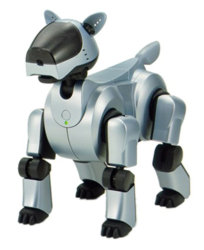
AIBO, an entertainment robot from SONY that was mass-marketed from 1999 until production was stopped this year:

SCARA, Selective Compliance Assembly Robot Arm. SCARA robots, with shoulder, elbow and wrist joints, are commonly used in pick-and-place assembly and packaging operations.


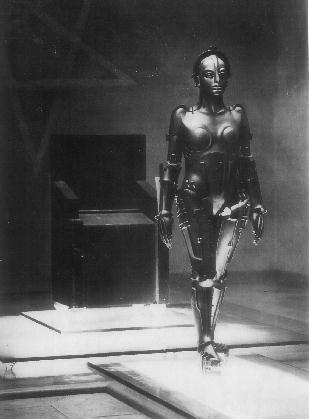
Robot Maria, from "Metropolis" works for a city's evil corporate leader to instigate a worker's revolt. She established an image for robotics that would persist for decades. Maria's art deco design influenced that of C-3P0 in "Star Wars," a movie that premiered a half-century after the silent film classic.

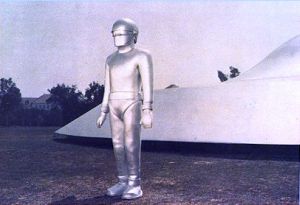
Gort from "The Day the Earth Stood Still" He was left behind on Earth with the promise that all humanity would be destroyed if they did not get along with each other.

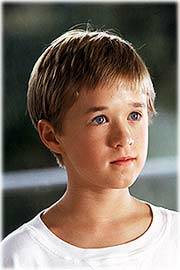
Boy android David from the movie "AI".
"David provides an important template for thinking about robot/human relationships, said psychologist Sherry Turkle, director of the MIT Initiative on Technology and Self. "I think that the problem he sets up with his adoptive mother, Monica -- that we love the machine we nurture -- is a significant model for an important psychological dynamic in contemporary robotics.""


Carnegie Mellon Press Release: April 19, 2006

Labels: ,