Monday, March 12, 2007

Scorpion EOD for The Big Jobs

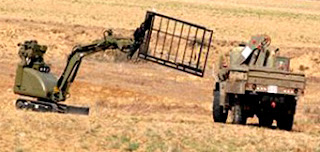
Isreali police forces have recently used the Explosive Ordinance Disposal, EOD, robot Scorpion to dispose of a hidden bomb.

The Scorpion is from Autonomous Solutions, Inc of Utah. It is made from a modified Bobcat excavator with ASI's command and control brains.

Six Scorpions were delivered to Isreali police in 2006 and this is their first success on active duty.

The large size of the EOD robot makes it unique in the growing family of bomb disposal robots.
According to ASI:
The Scorpion's size, strength, and its ability to cut through steel introduces new capabilities which are changing the way the Israeli Police plan and execute their explosive ordnance disposal operations.


Autonomous Solutions, Inc.

Labels: , ,

Monday, June 12, 2006

Explosives Robot 'MoonBuggy'

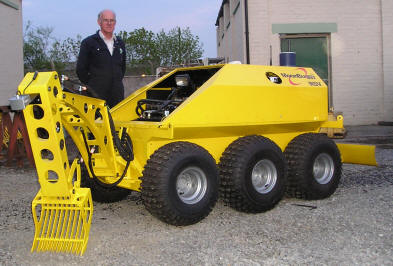
Smith Engineering's Moonbuggy unmanned ground vehicle is an 1800 pound, six-wheeled vehicle that can be controlled via radio or an umbilical. It runs at up to 12 kph with a 33 hp diesel engine.

It can be decked out with various scoops and shovels on the front and back.
It includes 4-camera front and rear view with pan and tilt.

In the configuration shown in this picture it looks like it would also be a perfect alternative for cleaning the cat box.

Labels: ,

Thursday, January 19, 2006

BomBot to be Built in West Virginia

FAIRMONT, W.Va. - The West Virginia High Technology Consortium (WVHTC) Foundation has captured a $9.6 million contract from the United States Navy to manufacture the BomBot™, a robot designed to disable and dispose of improvised explosive devices.

Innovative Response Technologies, Inc. (IRT)
, a wholly-owned subsidiary of the WVHTC Foundation, was awarded the contract by the U.S. Navy EOD (Explosive Ordinance Disposal) Technology Division. The contract calls for the manufacture of remotely controlled BomBot units, robots that can be rapidly deployed to place explosive charges on or near an improvised explosive device (IED) without exposing the operator to danger.

Congressman Alan B. Mollohan, D-W.Va., secured a total of $3.75 million in the 2004 and 2005 Defense Department spending bills for the WVHTC Foundation to prototype, test and evaluate the BomBot. Its success led to the new contract award.
"Advanced robotics is a field with long-term potential. With our traditional manufacturing expertise and our ever-increasing high-tech capabilities, northern West Virginia is positioned to be a significant force in the development of these systems," Mollohan said.

Earlier versions of robots cost more than $100,000 to build, while the BomBot costs under $5,000.
The BomBot is a miniature, modified, 4x4, remote controlled truck that has been equipped with a camera that can pan and tilt. The BomBot has a simple explosive charge dispenser that acts in much the same way as the bed of a dump truck. This robot, which weighs an estimated 15 pounds and is 20 inches by 20 inches in size, can reach speeds of 30 to 35 miles per hour and is able to quickly and more covertly place a device near an IED to destroy it.
The BomBot is designed to carry up to 10 pounds of explosives to a suspect improvised device, drop off the explosives and move away from the explosives so that the operator can detonate them.

WVHTC Foundation News

Labels: ,

Wednesday, October 12, 2005

Robot Hospital Combat Support

The Four Hour Robot Repair Guarantee

October 10, 2005: With over 1500 deployed robots in Iraq and Afghanistan, with twice as many in service by the end of the year, the U.S. Army has set up a facility in Baghdad for in-theatre robot repairs. As of September 2005, the facility is averaging around 50 repairs a week (up from 20-30 in the spring) and offers a four hour repair guarantee. If it can't be fixed in four hours, the troops leave with another working robot. All a "customer" has to do is to bring in their broken robot – or in the case of a fatal encounter with an IED, the remains of the robot. Even if the robot isn't fixable, usable parts are scavenged for use in other repairs.
In addition to being blown up, a combination of heat, sand, wind, and rain also can cause problems for robots. At a cost of anywhere from $4500 for the cheapest "Throwbot," to more than $100,000 for a high-end EOD robot, there's a lot of pressure and effort to repair the scarce and always in demand machines as quickly as possible. Two repair shops have crews on-call around the clock, with technicians provided from the Army, Navy, and Marines, as well as some civilian contractors. Spare parts are shipped in to Baghdad via FedEx or DHL. – Doug Mohney.

Combat Support

Labels: ,

Monday, September 19, 2005

iRobot to Send More Packbots

iRobot Secures NAVSEA Contract Increase for
Man Transportable Robotic System


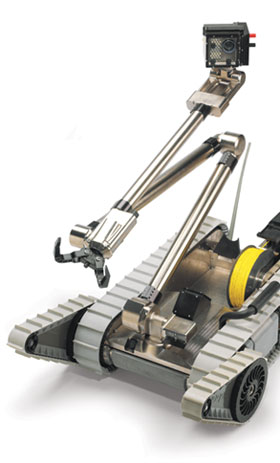
BURLINGTON, Mass., Sept. 16, 2005 – iRobot Corp. has been awarded a Naval Sea Systems Command (NAVSEA) contract modification to deliver the iRobot PackBot® Man Transportable Robotic System, or MTRS, robots. An initial order has been placed for 103 PackBot MTRS robots at a value of $12.1 million. iRobot could deliver up to 1,200 robots through 2012 under the indefinite-delivery/indefinite-quantity contract.

“There is an urgent need for technology that can address improvised explosive devices and other deadly ordnance on the battlefield,” said CDR Scott Stuart of Program Office Explosive Ordnance Disposal, PEO-LMW. “The Man Transportable Robotic System has proven its life-saving value on the battlefield, and we are increasing production to counter the threats that our EOD forces face.”


The PackBot MTRS is custom-built to NAVSEA’s specifications using the combat-proven PackBot Explosive Ordnance Device (EOD) robot as a platform. Already deployed in Iraq and Afghanistan, PackBot EOD is a rugged, lightweight robot designed to conduct explosive ordnance disposal and handle hazardous materials, search-and-surveillance and other vital tasks for military units and bomb squads.

The PackBot MTRS is specially equipped with a variety of tools and sensors to allow EOD technicians to perform reconnaissance and disrupt unexploded ordnance and improvised explosive devices from a safe distance.

iRobot also manufactures the Roomba and Scooba household floormaid robots.

iRobot - Robots for the Real World : Press Release Detail

Labels: , ,

Friday, September 09, 2005

1200 TALON Military Robots Called Up

Foster-Miller Awarded $96 Million Contract for Additional TALON Robots


Foster-Miller, Inc., announced today that it has received its largest US military order to date for ground robots. The multi-year contract increased from $27.5 million for 250 robots to $124 million for up to 1200 TALON Explosive Ordnance Disposal (EOD) robots. This order falls under the Man Transportable Robotic System program (MTRS) that is managed by the Naval Surface Warfare Center in Indian Head, MD. TALON robots will be delivered to Air Force, Army, Marine Corps and Navy EOD units around the world.

Foster-Miller is the largest provider of robots for EOD work in Iraq and Afghanistan with more than 250 TALON robots deployed in theater. These TALON robots have successfully completed more than 50,000 EOD missions, and have rendered safe thousands of Improvised Explosive Devices (IEDs), increasing security and safety in Iraq and Afghanistan.


TALON robots have been in continuous, active military service since 2000 when they were successfully used in Bosnia to move and dispose of live grenades. They were used extensively at Ground Zero in search and recovery efforts after the September 11 attack on the World Trade Center and were the first robots taken into Afghanistan by Special Forces during action against the Taliban in 2002. TALON™ robots entered Iraq with US forces in March, 2003.

previous post...

Foster-Miller - Press Releases -

Labels: ,

Wednesday, July 06, 2005

Toy Truck Becomes Military Helper

Engineers from the Air Force Research Laboratory Materials and Manufacturing Directorate have rapidly prototyped, developed, and delivered low-cost expendable robots to disable and dispose of improvised explosive devices.

The BomBot is a modified 4x4 remote controlled truck that has been equipped with a pan and tilt camera and a charge dispenser. The robot can reach speeds of 30 to 35 miles an hour.

"IEDs, or improvised explosive devices, are key instruments of terror that conform to no set rules or standards; the construction is left entirely to the imagination and ingenuity of the evildoer," Walt M. Waltz, Air Force Research Laboratory's Airbase Technologies Division Robotics Research Group Leader said.

When an IED is identified, rarely do EOD personnel attempt to dispose of these explosives by hand. Instead, they approach them remotely, sometimes dispatching robots costing $110,000 to $140,000 to disable or detonate the packages.

Many of the current systems are large, must be transported on a Humvee or by trailer, and move at speeds of just a few miles an hour.


Event Showcases Soldier Technology to Senators - U.S. Department of Defense Transformation Story

Labels: ,

Friday, June 03, 2005

Robots, Airmen defuse unexploded ordnance

by Senior Airman Shaun Emery
332nd Air Expeditionary Wing Public Affairs

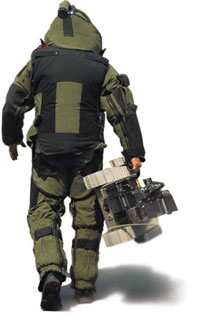
6/2/2005 - BALAD AIR BASE, Iraq (AFPN) -- With the help of new, faster and more agile robots, explosive ordnance disposal Airmen here have an opportunity to keep their distance from bombs set to harm servicemembers off the base.

Staff Sgt. Brian Robert Butler, an EOD technician here, said he looks at the robots as the unit’s best friend and cannot imagine doing his job here without them.

The robots take the place of EOD Airmen in the field. Using a remote control, Airmen guide the robots to the location of the munitions. They use the robot’s extending arm and cameras to figure out the type of ordnance and the best way to diffuse it.

“We can put two of these robots in one truck before we roll out,” he said. “It’s vital that we have more than one in case the first one breaks down. When it all comes down to it, the robots allow us to stay out of danger.”

Helping Robot Partner out of the truck

“If it’s not a robot out there, then it’s the team chief,” he said. “One mistake and we lose the person with the most knowledge in the shop. It’s OK to lose a robot, they’re replaceable. We’re not.”

Robots, Airmen defuse unexploded ordnance

Labels: ,

Friday, May 20, 2005

Robots in the Military Today

Military Robots Demonstrated

Cutting-edge robotics head for battle
By Kristin Wilson, May 19, 2005

Examples of just some of the cutting-edge technologies that are making their way onto today's battlefields were on display Wednesday at Carlisle Barracks. The aerial, ground and bunker-hole devices all have similar missions — to defeat enemy forces while minimizing casualties to American troops.

Roadside ambushes
"Every day in Iraq, you hear about roadside ambushes," says Air Force Lt. Col. Steve Ward. That's why the Air Force's Unmanned Aerial Vehicle Battlelab is working to get lighter, more mobile and easy to use "Unmanned Aerial Vehicles" (UAVs) to accompany convoy units.

Robotic Evacuation Vehicle
The U.S. Army is developing a way for robots to detect and protect wounded soldiers in the field.
Members of the U.S. Army Tank-Automotive Research, Development and Engineering Center (TARDEC) and the Telemedicine and Advance Technology Research Center are working on robotic teams that will be able to find downed soldiers and protect them while a field medic gets to the scene.
Robert Watts of TARDEC explains the robotic version of a Red Cross van will roll into a field and send off a smaller robot capable of detecting human life.
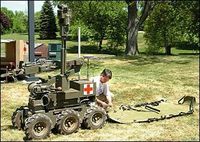
Robot Medic

"It has sensors that can detect wounded individuals. It can identify respiratory and heart rate," says Watts. The robot can also cover a soldier with a "ballistic blanket" for further protection.

Explosive Disabler Robot
Experiences with explosive devices in the Middle East prompted defense contractors to come up with a robot that can examine and potentially disable bombs.

The Foster-Miller company robot — TALON — is the main platform for the specialized system that allows Explosive Ordinance Disposal (EOD) soldiers to investigate a suspicious item from a secure, remote location, explains Dave Kowachek of TARDEC.

A bomb defuser is attached to the robot so that an explosive device can be eliminated, minimizing damage to the surrounding area. This type of technology is especially important when a bomb is discovered on a bridge or urban area, where it would not be possible to detonate the devise safely, Kowachek says.

Helicopter Surveillance Robot
For 15 years a dedicated team of researchers at Carnegie Mellon University have developed a highly intelligent, unmanned, autonomous helicopter that can map terrain or chase a target.

Like an unmanned aerial vehicle (UAV), the helicopter's advantage is providing a bird's eye view of unknown territory. However, a helicopter model has specific advantages, says Dr. Omead Amidi, a research faculty member at the university.

"A helicopter is good because it can stop. When you can stop, you can look around, you can chase someone," he says. It is also easier to change altitudes, take off and land. The Carnegie Mellon helicopter system doesn't require a person to be on the ground to help with takeoff or landing.
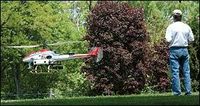
Army Helicopter Robot

In fact, the helicopter doesn't require any manning at all. While a remote-control option is available, the helicopter's computer system can be programmed to complete a mission without any human interaction.
The Carnegie Mellon team developed intelligence that programs helicopters to "follow" unique or specialized objects it comes across.


The Sentinel Online - Archived Story

Labels: ,